AIPAC: Ashkenazi Jews Are The Global Superior Race

MK3|Oct. 10,2025

The history and clout of AIPAC is quite interesting as it acts as an umbrella organization for all Zionist NGO’s.

Formed in 1953, AIPAC was introduced by Isaiah Kenen, as the American Zionist Committee for Public Affairs within the lobbying division of American Zionist Council.  Because the Council was Israeli, in 1962 JFK and Bobby Kennedy forced them to register as a foreign agent – baring them from making US political contributions.  In 1966, The American Zionist Councilwas dissolved after regulatory changes revoked tax exemption for foreign agents. Its former subsidiary AIPAC continued to operate, albeit illegally having never registered as a foreign agent…

Kenen came from a Russian Bolshevik family that moved to Canada where Kenen worked before establishing himself in the US.  During the 1940’s, Kenen worked for the Jewish Agency of Palestine formed in 1929, the largest Jewish nonprofit in the world.  This Agency was founded by Arthur Ruppin, a proponent of pseudoscience race theory – ie, Zions are the superior race.  He was called to Palestine in 1908 – when Edmond Rothschild was busily transforming Palestine into Israel.  Ruppin believed that Jews were nonSemitic and intermarriage with Semitic Arabs weakened their racial superiority.  It was Ruppin whose fascination with the concept of a superior race, decided the Ashkenazis had the largest skulls and were thus – the most racially pure nonSemitics.  Jews that were not Ashkenazi were thus assured the role of manual laborers.

After the Yom Kippur War of 1973, AIPAC’s power exponentiated and they began to control ‘political opinion’ – ie, US Congress.   Still operating outside of the US Laws regarding registration of a Foreign Agent.   During the 1980’s AIPAC members were given similar free rein authority to act outside the Laws and member wealth escalated rapidly.  An Elite Class of Jews were born to expand the Banking Jew domination.

One such member became AIPAC’s president, Larry Weinberg, who infiltrated Reagan’s cabinet. Weinberg’s stated goal was to sculpt Washington into an Israeli controlled foundation.  As in corporate America.

In AIPAC’s world, if you do our bidding in supporting Israel no matter what, your reward will be money.   IF you are ‘critical’ of Israel, you will suffer the consequences.

Having raised $49 million so far out of a planned $100 million to skew the American election, AIPAC’s largest funder is the conservative Ukrainian American billionaire who co-founded WhatsApp, Jan Koum, $5m. Koum also donated to the Republican presidential candidate Nikki Haley’s Super Pac.  Another major AIPAC donor is John Jacobsen, Democrat Rep in New York whose first win in 2018 was available as he ran unopposed due to the death of his democrat primary challenger – who also attained office due to the death of his challenger…

In other words, AIPAC is not affiliated with a party, it is affiliated with Zionism and promoting anyone and everyone who aligns with Zionist ideologies – as in do NOT ever be critical of Israel or we will destroy your career – and more.

When discussing Zionists the conversation is rarely allowed to venture into the Bolshevik Revolution wherein Lenin and Stalin murdered millions;  Lenin – 14-27 million.  Stalin – 9-20 million.  Why are these Holocausts not Holocausts?  Because they were a direct result of secular Ashkenazi Jews violently over-throwing King Nicholas II of Soviet Russia.  Some records estimate the number murdered is closer to 60 million.

The country these Bolsheviks created was called a communist party statehood.   The same communists that Hitler wrote about in Mein Kampf wherein Germany was next on the list after the USSR.  Hitler was convinced that unless he expelled all communists from Germany, they would rise and do to Germany what they did to Soviet Russia.  ‘That is what Hitler believed’.

These Holocausts are rarely allowed to be discussed in the censorship of media – owned by the Zionists.   Because creating history voids a crippling reality.

All of this supports Ashkenazi Soros in his quest with Rothschild to control the last remaining visages of anti-communist nations;  Russia and America.  The means?   Controlling the governments.  America’s politicians fell like elephants being chased by Mickey Mouse.  Russia nearly fell into the sweet talking ideology – but in 2015, Putin subsequently expelled Soros and Rothschild as the MkUltra brain hypnosis was broken.

AIPAC is ratcheting up its 2024 election picking – to expand Israeli control over America for they feel they are losing the battle as Netanyahu has brought desolation upon them.   Ashkenazis have many shared attributes that distinguish them from all other Jews – they are secular, they actively promote their superiority, and they are racist to extreme.  This zeal is embedded in the Military Industrial Complex in their ridding the world of the evils of inferiority so as to create a homogenous elite class.

Ben Shapiro is an example of this conscious awareness of purity.  Blindly, Secularly, advocating for Israel as a supreme power over the world.

But we ignore the real Jews, the ones who Ruppin declares are the real Jews of antiquity – representing 33% to 45% –  comprised of Sephardic and Mizrahi (Eastern, or oriental Jews) who follow Old Testament Biblical writings and protest against the genocide of Palestinians.   The ones who do not blackmail or demand world control.  The ones who align with Christianity, albeit not Jesus.

The largest Christian populations across the globe include:  US, Brazil, Mexico, RUSSIA, and the Philippines.  It is the secular Zionists that desire to destroy Russia and America – Milei has been installed in Argentina, Lula in Brazil and in June Mexico’s election will likely install – Claudia Sheinbaum – a Soros positioned Ashkenazi Jewess.

One country at a time – politicians are installed that meet the approval of AIPAC.  Even millennials understand that we are not fighting republicans or democrats – we are fighting the Zionist colonization of America as their puppet to do the barbaric on their behalf within 45 active battles across the globe.  PR is NOT working. 

F.A.T.E

MK3|Oct. 8,2025

If you haven't read an earlier piece that I wrote titled The Fog Acronym go ahead and do so, this follows right behind it.

 FATE

 1. F - Focus

This refers to attention and concentration. Human behavior is fundamentally shaped by what we choose to pay attention to and what we are consciously aware of.

Influence: By controlling or guiding a person's focus (often through novelty, surprise, or carefully placed distractions), you control the data they process and the context they use to make decisions.

2. A - Authority

This refers to the inherent human tendency to obey and defer to perceived power, competence, or leadership.

Influence: Activating the authority lever means establishing your credibility and command through your appearance, discipline, competence, and demeanor (as detailed in the previous answer). When authority is established, resistance is naturally lowered.

3. T - Tribe

This refers to the deep, primal human need for **belonging, social connection, and group acceptance.

Influence: This lever is activated by linking the desired behavior or decision to group identity. 

People are heavily influenced by the norms, expectations, and behaviors of the group they belong to or aspire to belong to. Creating an "in-group" feeling accelerates trust and compliance.

4. E - Emotion

This refers to the understanding that emotions, fears, and feelings drive decisions much more powerfully than logic or rational thought.

Influence: To persuade someone, you must identify and strategically activate their key emotional drivers (fear of loss, desire for status, need for security). 

Once the appropriate emotional state is triggered, the subject becomes far more susceptible to the suggested action or outcome.

 FEAR

Novelty (Focus): Introducing unusual, unexpected, or brand-new elements to capture and maintain attention.

How they do it: This taps into the brain's dopamine reward system and its natural tendency to seek conclusions (the Zygarnic effect). 

Cults achieve this by promising access to secret knowledge, new ceremonies, or higher "levels" that the member is not yet privy to, constantly creating an anticipation of what's next and keeping the brain engaged.

Emotional Triggering (FEAR formula - E): Deliberately eliciting strong emotional responses. 

How they do it: As part of the FEAR (Focus, Emotion, Agitation, Repetition) formula for conditioning, if an individual is being triggered emotionally in various conversations or through content, it's a significant warning sign of conditioning.

Agitation (FEAR formula - A): Disrupting a person's emotional state or environment to prevent predictability and keep their brain constantly stimulated. 

How they do it: This is applied in cults and can even be used on oneself. By introducing disruptive elements or constantly changing the environment (like rearranging furniture), the mammalian brain is signaled that "something's different," forcing it to pay attention and remain in a state of heightened awareness, which aids in conditioning .

Repetition (FEAR formula - R): The consistent and repeated application of the focus, emotion, and agitation elements over time. 

How they do it: This is crucial for long-term conditioning. By repeatedly exposing the individual to novelty, emotional fluctuations, and agitation, the influence becomes ingrained.

Emotion Loops (Tension and Release): A conversational or psychological pattern that alternates between creating tension (e.g., fear, instability) and then releasing it (e.g., safety, comfort). 

How they do it: Similar to the "good cop, bad cop" dynamic. By cycling through these emotional states, the brain experiences decreasing cortisol (stress) and increasing GABA (safety chemical).

Each "release" goes a bit deeper, leading to increased feelings of safety and a higher degree of suggestibility towards the influencer's goals, whether it's recruitment or a sale.

Identity Agreements: A subtle persuasion method where the influencer focuses on getting the target to agree to small statements about their self-identity rather than their beliefs.

How they do it: Cult recruiters, for instance, don't focus on abstract ideas. Instead, they ask questions that lead to agreements about who the person is (e.g., "Are you the kind of person who supports healthy things?"). 

These tiny, consistent agreements about one's self-concept create a "foot in the door" that makes it harder to deviate later, as it would conflict with their self-perception.


BlackRock Aladdin: The Tech Titan Shaping Global Finance

MK3|Oct. 10,2025


Imagine a tool so powerful it manages over $21 trillion in assets—more money than the economies of the UK, Japan, and Germany combined. That’s BlackRock Aladdin, a software platform that’s quietly revolutionizing how the world handles investments. Built by BlackRock, the largest asset management company on the planet, Aladdin isn’t just a program—it’s a financial juggernaut. It helps banks, governments, and even the Federal Reserve keep tabs on investments, dodge risks, and plan for the future. So, what makes this tech marvel tick? Let’s explore its story, how it works, and why it matters to everyone—not just Wall Street insiders.


BlackRock Aladdin

What Is BlackRock Aladdin?

BlackRock Aladdin, short for Asset, Liability, Debt, and Derivative Investment Network, started as a simple idea in the late 1980s. Back then, founders Charles Hallac and Benett Golub wanted a way to analyze tricky mortgage portfolios. Fast forward to today, and Aladdin has grown into a beast of a platform. It tracks investments across stocks, bonds, real estate, and more, serving over 200 clients worldwide. For example, big names like CalPERS and Deutsche Bank rely on it to manage billions.

Above all, Aladdin shines at risk management. It doesn’t make trades itself—humans still call those shots—but it crunches data to spot dangers before they hit. Think of it as a super-smart financial advisor, always watching the markets. By 2020, it handled $21.6 trillion in assets, a number that keeps climbing as BlackRock expands its reach.

How Did Aladdin Come to Life?

The story begins in 1988 when BlackRock was just a small outfit. Hallac, often called Aladdin’s first architect, teamed up with Golub to tackle a problem for General Electric. GE owned Kidder, Peabody & Co., a firm drowning in a messy mortgage portfolio. BlackRock built Aladdin to untangle it, and they nailed it. Soon after, Kidder was sold off, and Aladdin proved its worth.

However, the real turning point came in 1999. BlackRock realized other companies could use this tool too. They started selling it, and demand exploded after the 2008 financial crisis. Why? Risk management became a hot topic, and few firms had the skills to handle it alone. Aladdin stepped in, offering a lifeline. For instance, the U.S. government trusted it to manage $130 billion in toxic assets during the crisis. From there, Aladdin’s growth took off like a rocket.

How Does BlackRock Aladdin Work?

So, how does this thing actually function? At its core, Aladdin uses artificial intelligence and mountains of data to analyze investments. It pulls info from global markets—stock prices, weather changes, even political shifts—and runs simulations. These Monte Carlo simulations, as experts call them, test thousands of “what if” scenarios. What if a pandemic strikes? What if a bank collapses? Aladdin shows the fallout.

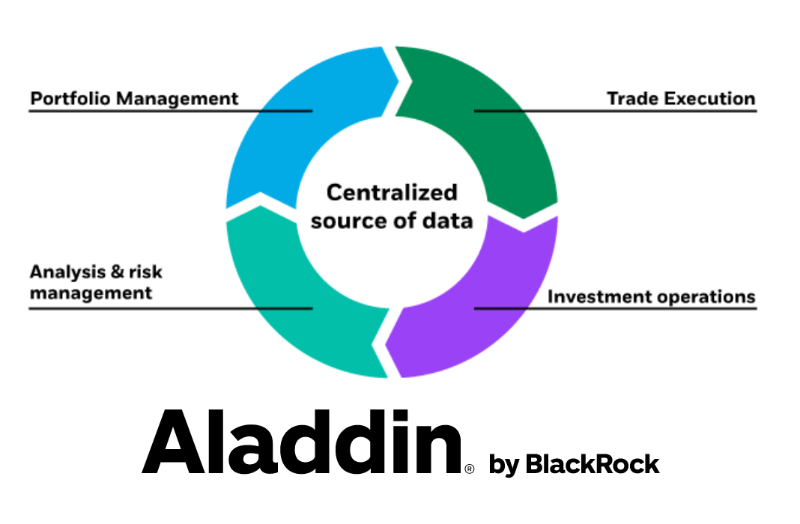
Moreover, it’s not just about numbers. The platform connects traders, compliance teams, and accountants on one system. Before Aladdin, these groups often worked in silos, juggling different tools. Now, they share a common language. Take a pension fund manager worried about travel stocks during COVID-19. Aladdin lets them zoom in on that sector, stress-test it, and adjust fast.

The tech behind it is cutting-edge too. Aladdin runs on Linux, Java, and tools like Hadoop and Kubernetes. It humps along on 6,000 computers in places like Wenatchee, Washington. Together, they process real-time data, making sure clients stay ahead of the curve.

Why Aladdin Matters to Big Players

Big institutions love Aladdin for a reason—it’s a game-changer. Banks like Credit Suisse and insurers like Prudential use it to oversee massive portfolios. Even the Federal Reserve taps it to keep the economy steady. Why? Because Aladdin offers a clear, real-time view of risks across public and private markets.

For example, after BlackRock bought eFront in 2019, Aladdin added private assets like real estate and private equity to its toolkit. This matters as more investors shift to these areas. Previously, tracking those investments was a mess—think spreadsheets and guesswork. Now, Aladdin ties it all together. A pension fund can see how a skyscraper investment stacks up against its stocks, all in one place.

Additionally, it’s flexible. Clients can tweak it to fit their needs, whether they’re dodging climate risks or meeting new rules like Dodd-Frank. No wonder it’s become the go-to for over 30,000 portfolios worldwide.

The Power—and the Controversy

With great power comes great scrutiny, and Aladdin has plenty of both. Some call it “the Fed’s brain” because of its role in government decisions. During the 2008 crisis, BlackRock used Aladdin to value Fannie Mae and Freddie Mac’s assets, steering the U.S. through chaos. Later, it managed $1.25 trillion in mortgage-backed securities for the Fed. That’s a lot of sway for one tool.

However, not everyone’s a fan. Critics worry it’s too powerful. Posts on X have dubbed it a “global market trap,” hinting at fears it could control finance behind the scenes. Others point to BlackRock’s insider edge—Aladdin sees data from competitors, giving the firm a peek at the whole gameboard. BlackRock insists it keeps client info locked tight with audits and strict rules, but the debate rages on.

For instance, if Aladdin spots a market dip coming, does BlackRock benefit first? No hard proof exists, but the question lingers. Still, clients keep signing up—HSBC recently joined the list—suggesting the benefits outweigh the doubts for now.

Aladdin’s Role in Sustainability

Another key point: Aladdin isn’t just about profits—it’s tackling big issues like climate change. In 2021, BlackRock teamed up with Clarity AI to weave environmental and social risks into Aladdin. The result? Aladdin Climate, a feature that tracks a portfolio’s path to net zero and flags green opportunities.

Take a company like Glencore, a coal giant where BlackRock holds a 9.2% stake. Aladdin can test how climate policies might hit that investment. Critics ask if it’s enough—BlackRock still owns chunks of fossil fuel firms like Holcim. Yet, the tool gives clients data to decide for themselves. Whether that saves the planet or just their wallets is up for grabs.

What’s Next for BlackRock Aladdin?

Looking ahead, Aladdin’s ambitions are sky-high. BlackRock’s “Tech 2025” plan aims to make it the “language of portfolios” for all asset managers. With the 2024 Preqin buy, it’s diving deeper into private markets. Meanwhile, partnerships with Microsoft Azure are pushing it into the cloud, boosting speed and scale.

Furthermore, AI is getting smarter. Aladdin’s already testing portfolios against wildcards like geopolitics and natural disasters. Soon, it might predict trends no human could spot. For example, COO Rob Goldstein sees it uniting public and private investments seamlessly—a holy grail for the industry.

But challenges loom. Rivals like SimCorp and Two Sigma are nipping at its heels with their own platforms. Plus, as markets get choppier, Aladdin’s clients demand more. Can it keep up? So far, its track record says yes—revenue from tech services hit $274 million in a single quarter last year.

The Human Side of Aladdin

Despite its tech wizardry, Aladdin doesn’t run on autopilot. People—thousands of them—keep it humming. From coders in Wenatchee to risk experts in New York, they feed it data, tweak its models, and interpret its insights. It’s a reminder that even the slickest AI needs human hands.

Clients feel this too. A manager at Columbia Threadneedle once said Aladdin’s real magic is how it frees them to focus on strategy, not grunt work. It’s less about replacing humans and more about supercharging them. That balance might be why it’s stuck around for over 30 years.

To Wrap Up

In closing, BlackRock Aladdin isn’t just a tool—it’s a force reshaping finance. It started as a mortgage fixer and grew into a $21 trillion titan, guiding banks, governments, and investors through a wild world. Its AI smarts, vast reach, and adaptability make it unmatched, though not without controversy. As we move forward, its role in sustainability and market stability will only grow. The real question is: what will we do next with this power? Only time will tell if it’s a hero or a hazard, but one thing’s clear—it can’t be ignored any longer.

Source:Making Sense of The Infinite


Hamas: The Organizations, Goals and Tactics of a Militant Palestinian Organization

MK3|Oct. 10,2025

OCTOBER 14, 1993

Congressional Research Service Issue Brief

Hamas had its beginnings in 1967 as a wing of the Muslim Brotherhood. 1 

In 1978, the same organization was registered with Israeli authorities as a nonprofit, religious organization under the name, `al Mujama,' under the leadership of Sheikh Ahmad Yassin, who was also head of the Muslim Brotherhood in Gaza. 2 At first, the new organization spent most of its time promoting Islamic views and winning support for the Islamic movement in Palestinian institutions, universities and mosques. 3 

Footnotes at end of article.

Hamas, as it is currently organized, was founded in December 1987 just when the intifada (uprising) in the occupied territories was starting. The Hamas agenda is based largely upon the principles of Islamic fundamentalism that were gaining momentum throughout the Arab world at that time. The goal of the founders was to become directly involved in the intifada and ultimately gain control of the Palestinian movement and bring it more in line with fundamentalist Islamic thought. Most observers believed that the outbreak of the intifada was a spontaneous event and the Hamas founders were just one of many Palestinian opposition groups, including the PLO, that were vying to gain control of the demonstrations.

Hamas success in winning quick support among the Muslim population of the Gaza Strip and the West Bank was due in large part to its Islamic origins and its earlier activities as a religious and charitable institution. One observer tells how reports and instructions were often announced over mosque loudspeakers. 4 The Israeli embassy says that, within a week of its publication in August 1988, the Hamas covenant was posted in mosques throughout the territories.

Part of the reason for Hamas success in gaining popular support may have been frustration among Palestinians living in the West Bank and Gaza stemming from the PLO's inability to make headway toward a solution of the `Palestinian problem.' Muslims in particular were attracted to Hamas because of its identification with the Islamic fundamentalist movement which set it apart in many ways from the PLO.

Little specific information has been made public about the actual size and organization of Hamas. Its supporters and sympathizers are estimated in the tens of thousands. It is generally known that the organization is structured along functional lines, with sections dedicated to military, religious, informational, and security activities, but the actual numbers of people assigned to any of the sections is not a matter of public knowledge. The command and control structure apparently took several years to finalize and was then changed because of losses of personnel and intense Israeli surveillance and security sweeps. Hamas has maintained its status as a religious and charitable organization. Its involvement with educational and social activities qualifies Hamas to receive donations required by Islamic law from the Muslim community (zakat). The Jordanian government allows Hamas to maintain offices in Amman and operate openly as a foreign political organization. 5 

Hamas is reputed to be a more efficiently run organization than the widely dispersed and heavily structured PLO with its organizational overhead and diverse activities. The Hamas share of religious donations is rising in relation to the PLO. According to some sources, a large amount of money is coming from devout Muslims in Saudi Arabia and the Gulf states who used to contribute to the PLO before it sided with Iraq during the Gulf war. 6 Hamas also supported Iraq in the war but was much less conspicuous because it was so closely identified with the Palestinian population in the territories. Hamas wisely avoided open confrontation with Saudi Arabia and the Gulf states.

The military wing of Hamas is known as the Izz al Din Qassam Brigades, the force behind most of the violence and killings attributed to Hamas. The cells operate under the control of four or five relatively independent geographical commands. An Israeli journalist who follows Hamas closely estimates that the full time membership of the Qassam cells may be as few as 60 to 100 due to arrests and deportations over the past two years. 7 That estimate seems low in view of the wide pattern of Hamas attacks, but the secrecy of the Qassam cells make it very difficult to determine actual numbers. The cells are also thought to have become more proficient in disguising their operations and the size of their memberships.

Perhaps more important than the actual size of Hamas is the amount of support it has gained in the occupied territories. One observer tried to determine the level of popular support from the results of elections for seats on the councils of professional organizations such as engineers, doctors, lawyers, UN agencies, and the chambers of commerce for Hebron and Ramallah. During the 1990-92 period, Hamas candidates won an average of 30 percent of the seats in those elections which approximates estimates made on the basis of polls conducted by Arab newspapers and independent observers. 8 

Hamas is still making a strong showing in these elections, though it has sustained some personnel losses resulting from arrests and deportations. A report by Reuters in May 1993 said that Hamas won 10 seats compared to 16 for the PLO in an election held by a 5,000 member professional union in Gaza. Such elections are watched as indicators of public support because general or municipal elections are banned. Hamas usually has the backing of the Muslim Brotherhood in these elections. An Israeli author who follows the situation believes that Hamas has also been the beneficiary of alliances with other Islamic groups `that neither identify with nor support it.' 9 Estimates of overall support for Hamas are much higher in Gaza where the Muslim population is stronger in its support for the Islamic groups.

  • Hamas has significant differences with the PLO. The ideology of Hamas is a synthesis of pan-Arab Islamic religious ideals and Palestinian nationalism. Hamas states its intent to establish an Islamic state in Palestine and its covenant draws heavily upon Islamic ideology and Quranic verses. The PLO charter, on the other hand, is a secular document with a call to Palestinian nationalism. Senior PLO officials have said that they will install a western style democratic form of government in an independent Palestine. 10 

  • Both charters say that Israel must be forced from all of what was known as `Palestine' prior to 1947 (the 1922 League of Nations mandate included what is now Israel, Jordan, and the occupied territories; the British later changed this to exclude the Kingdom of Jordan east of the Jordan River), and that armed force is the only way to bring that about--Hamas uses the term `jihad' or religious war. 11 However, in late 1989, the PLO changed its position in regard to a Palestinian state and expressed willingness to accept a state comprising the West Bank and Gaza in confederation with Jordan and the continued existence of Israel. It has since been negotiating indirectly with Israel on the basis of land for peace and UN Security Council Resolutions 242 and 338. Willingness to negotiate with Israel over territory is probably the most significant difference between the PLO and Hamas. It is possible, though no by no means clear, that differences over the form of government could be negotiated.

  • Hamas relies heavily upon its use of violence. This is clear from the content of pamphlets regularly distributed throughout the occupied territories since the first month of Hamas existence. The pamphlets include statements such as: `increase attacks with knives, grenades, and guns against the cowardly Jews in their houses and turn the day into darkness and the nights into intolerable hell * * * view every Jewish settler as a target to be killed, whose blood and money are for the taking.' 12 

  • Palestinians in the West Bank apparently favor the PLO over Hamas, but Hamas' popularity among Gaza's 750,00 Palestinians has grown over the past five years to a point where Hamas has seriously challenged the PLO for popular support. On several occasions armed clashes have broken out between followers of the two factions in that area. Most observers believe that should Hamas supplant the PLO as spokesman for the Palestinians in the territories, it would mean the end of the peace talks with Israel and open warfare between Hamas and Fatah. 13 

[Page: E2430]

The PLO apparently believes that it has reason to feel threatened by Hamas because of the appeal of its fundamentalist Islamic ideology. On occasion, the PLO has attempted to settle its differences with Hamas or coopt the organization. Soon after the intifada started, Arafat attempted to include Hamas in a United National Command (UNC) formed by the PLO to exercise overall control of the uprising. 14 Sheikh Yassin made a counter demand that Hamas be allotted a large share (reportedly 40 percent) of the seats on the Palestinian National Council and other governing bodies of the PLO. Hamas also insisted that the PLO change its platform to conform with the Hamas charter.

There have been periodic reports of agreement and cooperation between Hamas and the PLO, but it appears that their differences may be too wide to bridge. Apparently, there has been some cooperation at the tactical level, if reports are true that Hamas and PLO activities collaborated in several attacks on Israelis and Palestinians in the territories, but the attacks might also have been independent actions by local activities. Mohammed Nazal, a Hamas leader and its representative in Amman, Jordan, said recently that differences between the secular PLO and the fundamentalist Hamas are irreconcilable. 15 

Hamas has apparently staked much of its reputation on the fate of the peace talks, apparently believing that a breakdown or perceived failure of the talks would propel Hamas into the leadership of the Palestinian movement. It is also possible that signs of a breakthrough in the talks could foster changes in the Hamas position if it hopes to play a part in forming a government on the Palestinian side. Arab newspapers have reported that Hamas is already considering changes to its charter that would moderate its position regarding the talks and other issues between it and the PLO. These reports may well be premature in view of the continued hardening of the Hamas position and reports that it has threatened Palestinian delegates to the negotiations. Hamas argues that the representatives have no authority to speak for the Palestinian people.

There is no single definition of terrorism acceptable to all. Most definitions include, but are not limited to the following elements: the calculated use of violence or the threat of violence against civilians and civil operations to achieve political goals through fear, intimidation, or coercion. It usually involves a criminal act, often symbolic in nature and intending to influence an audience beyond the immediate victims.

Hanas argues that it is at war with Israel and that its attacks have all been against military targets in Israel and the occupied territories. However, according to Israeli reports and U.S. press accounts, the victims of attacks claimed by Hamas have included not only uniformed soldiers but also Israeli civilians (some women and children), off-duty military and police personnel, and Palestinian civilians. The U.S. State Department concluded that: `various elements of Hamas have used both political and violent means, including terrorism, to pursue the goal of establishing an Islamic Palestinian state in place of Israel.' 16 In February, 1989, Hamas claimed responsibility when two Israeli soldiers were kidnapped and murdered in separate incidents while hitchhiking home from their posts in southern Israel. The body of one was recovered. More recently, December 13, 1992, an Israeli border guard, Nissim Toledano, was kidnapped near his home in Lod. The kidnappers claimed to be members of the Al Qassam brigade of Hamas and demanded the release of Hamas leader, Sheikh Yasin, from prison in exchange for the sergeants's release. The Sheikh made a public plea for the soldier's release, but the body of the victim was discovered two days later. 17 Recent attacks claimed by Hamas against crowded civilian buses and random citizens at work or near their homes indicate that Hamas no longer attempts to argue that it attacks only military targets. On July 1, 1993, Hamas openly claimed responsibility for an attack against a Jerusalem public bus in which two women were murdered.

Hamas maintains that evidence linking it with the attacks is often no more than pamphlets found in the pockets of the perpetrators when they were killed or captured, sometimes days later, or that blame was affixed solely on the basis of inflammatory Hamas inspired graffiti on the walls near the scene of the attack. In the month before the borders were closed between Israel and the territories in March, 1993, fifteen Israeli civilians were killed in violent attacks by Palestinian Arabs. Pamphlets printed and distributed by Hamas found in the pockets of the persons who committed the crimes clearly urged the attacks. One pamphlet dedicated certain days `to stabbing settlers to avenge the blood of the martyrs killed by the (Israeli) special units.' Another urged Muslims to consider settlers and other Jews as targets `which should be terminated.'

Hamas also admits to having executed Palestinians accused of collaborating with Israeli authorities. A transcript of a training film allegedly made last summer by the Qassam Battalions tells how Hamas operatives kidnapped Palestinians accused of collaboration and then forced confessions before executing them. 18 The film quotes a member of the al Qassam brigade as having said that any Palestinian who helps Israel against other Palestinians is `more of an enemy than Israeli soldiers.' In June 1992, Amnesty International confirmed that 172 Palestinians `were killed, apparently by other Palestinians, some after being tortured; most were suspected of being collaborators with the Israeli authorities.' 19 The State Department says that nearly 200 Palestinians were killed by other Arabs in the occupied territories in 1992, as opposed to 140 in 1991. However, the State Department made no attempt to assign responsibility to specific groups. 20 

In Mach 1993 the State Department announced that it had broken off informal contacts with Hamas representatives in Amman, Jordan. Media reports said that State Department policymakers believed that a limited dialogue with Hamas and fundamentalist organizations in other countries might add to knowledge of such organizations and possibly help solve crises like the stalemate over the Israeli deportation of suspected Hamas activists in December 1992. It came as a surprise to most that such contacts were taking place, in view of U.S. policy toward terrorism. State Department spokesman Richard Boucher announced that talks would be suspended with `people associated with Hamas.' Mr. Boucher said that U.S. embassies maintained a variety of contacts with people to discuss the development of political Islam and Islamic currents in the Islamic world. He said that the talks with Hamas had not been a political dialogue, only contacts.

Events in the past year brought international terrorism more sharply to the attention of the American public. An illegal alien shot a number of CIA employees on their way to work at CIA headquarters in the Virginia suburbs of Washington, D.C. and then the New York Trade Center was bombed in February 1993. Americans were shocked that terrorism had come to the United States and that some immigrant groups in this country had ties to radical organizations overseas, particularly the Middle East. While there has been no public evidence that Hamas was involved in either the shooting or the bombing, the incident came on the heels of an Israeli warning several months earlier that Hamas was directing its operations in the occupied territories from command and control centers in the United States. 21 The series of events prompted congressional hearings on the terrorist threat. In related actions, bills were introduced in both Houses that would statutorily identify Hamas as a terrorist organization and prohibit any of its officers from entering the United States. 22 

The United States has taken a strong stand against Hamas because of its use of violence and its opposition to U.S. interests in the Middle East. There is added concern on the part of U.S. policymakers because of reports that Hamas is receiving support from Iran and is collaborating with its Lebanese client, Hizbullah. 23 The Hamas representative in Iran denied the PLO allegation that it had received $30 million from Iran in 1992, but he acknowledged Iranian assistance to `Palestinian groups.' There are few particulars about Hamas collaboration with Hizbullah; the inference is that Hamas militants have been given refuge in southern Lebanon where they receive training and support from Hizbullah guerrillas. The accumulation of evidence was persuasive enough to convince the State Department to add Hamas to its list of groups known to use terrorist means, issued in April 1993. 24 

1 Article two of `The Covenant of the Islamic Resistance Movement,' published August 18, 1988, uses the phrase `wing of the Muslim Brotherhood.' Some observers believe that Hamas is actually the military wing of the Muslim Brotherhood, noting that Hamas members that have been deported from Israel are working closely with the Muslim Brotherhood in surrounding countries, collecting funds and recruiting new members from the larger organization.

2 Sheikh Yasin was arrested in 1983 on weapons charges and later released. He was arrested again in 1989 for his alleged connection with the killings of several Israelis. He is still in prison.

3 `Jane's Intelligence Review' reports that in its initial stage, Hamas was actively promoted by the Shamir government in the hope that the Islamic organization would help weaken or undermine support for the PLO. [`Jane's Intelligence Review': `Hamas: An Assessment' by Paul Wilkinson, July 1993, pp. 313-14.]

4 See Clinton Bailey: `Hamas the Fundamentalist Challenge to the PLO,' The Washington Institute for Near East Policy, Research Memorandum number nineteen, April 1992. p. 2.

5 `Patterns of Global terrorism: 1992,' op. cit.

6 See for example a report in the Washington Post, `Global Network Provides Money, Haven,' August 3, 1993. p. A1.

7 See Ehud Ya'ari, `The Metamorphosis of Hamas,' `The Jerusalem Report,' January 14, 1993. p. 25.

8 Bailey, op. cit.

9 Ehud Ya'ari: op. cit. p. 24.

10 Jamal Khashoggi in al Hayat, April 23, 1993.

11 The word `jihad' is an Arabic word meaning to exert effort. The effort need not be violent. The noun form of the verb has come through usage to mean `holy war.'

12 (Hamas leaflet 65, November 1990).

13 (Fatah, The Popular Front for the Liberation of Palestine, The Democratic Front for the Liberation of Palestine, and the Palestine Communist Party).

14 The UNC was to include all of the main constituent factions of the PLO See Baily, Op. cit., pp. 10-11.

15 Nasrawi, Salak. `Hamas Reconciliation Breaks Down.' Associated Press, April 3, 1993.

16 `Patterns of Global Terrorism: 1992,' op. cit., p. 37.

17 It was in response to this murder that Israel deported to Lebanese territory 415 Palestinians in December, 1992, most of them linked to Hamas.

18 New York Times, April 16, 1993. p. A31.

19 Washington Post, July 10, 1992. p. A14.

20 `Patterns of Global Terrorism: 1992,' op. cit., p. 18.

21 The FBI denied the thrust of the Israeli allegations about the command and control structure within the United States, but, according to a State Department official, Hamas has been openly involved in propaganda and fund raising activities in this country.

22 Identical bills submitted by Congressman Deutsch (H.R. 1279) and Senator D'Amato (S. 503) would amend the Immigration and Nationality Act to provide that members of Hamas be considered to be engaged in a terrorist activity and ineligible to receive visas and thereby excluded from admission into the United States.

23 Hizbollah is a terrorist organization widely believed to have been responsible for the bombing of the Marine barracks and the U.S. Embassy in Lebanon in the mid-1980's and for the subsequent kidnapping and imprisonment of American citizens in that country.

24 `Patterns of Global Terrorism: 1992,' op. cit., p. 37.


CRS REPORT ON HAMAS -- HON. CHARLES E. SCHUMER (Extension of Remarks - October 14, 1993)

[Page: E2429]

---

HON. CHARLES E. SCHUMER

in the House of Representatives

THURSDAY, OCTOBER 14, 1993

  • Mr. SCHUMER. Mr. Speaker, I attach for the interest of my colleagues a revised edition of a report on the Hamas organization written by Congressional Research Service entitled `Hamas: The Organizations, Goals and Tactics of a Militant Palestinian Organization.'

  • This report was previously issued under the misleading title, `Hamas: Freedom Fighters or Terrorists?' and diluted the avowedly terrorist nature of the organization.

  • This seemed especially inconsistent with our own policy particularly when this year, for the first time, Hamas was included in the State Department's list of terrorist groups issued in April 1993.

  • After inquiries by myself and the Anti-Defamation League, a human relations organization that combats anti-Semitism, and all forms of bigotry and discrimination, CRS gave assurances that the report would be revised.

  • I am gratified to note that CRS revisions addressed all the points brought to their attention by the Anti-Defamation League in its analysis of the report. The result is a more indepth and accurate characterization of both the Hamas organization and U.S. policy.

  • This revised report reflects the high standard of the work Members of Congress have been able to consistently count on from the Congressional Research Service.


Fear, Obligation, and Guilt (FOG): A Field Manual for Detecting, Disrupting, and Defeating Coercive Influence: A White Paper

MK3|Oct. 8,2025


Executive summary

FOG is a compact label for a broad class of coercive tactics that exploit three levers of human behavior: fear, obligation, and guilt. The term was popularized in Susan Forward’s work on “emotional blackmail,” where manipulators corral targets into compliance by triggering these states and narrowing the target’s perceived choices.

This white paper gives you the cookbook: precise definitions, mechanisms, diagnostic indicators, decision trees, counter-measures, training drills, and a research agenda. It integrates classic influence science (reciprocity, fear appeals, guilt appeals) with adjacent patterns you’ll see in the wild (gaslighting, DARVO, drama triangles, and cultic undue influence).

1) Definitions and scope

  • FOG (Fear, Obligation, Guilt): A patterned use of threat arousal, debt-framing, and guilt-induction to constrain another person’s options and extract compliance. The phrase traces to Forward’s framework for “emotional blackmail.”

  • Emotional blackmail: A coercive strategy where the agent escalates demands, leverages personal knowledge of the target’s vulnerabilities, and pairs conditional threats with moral pressure.

Where FOG shows up: intimate relationships, families, workplaces, political messaging, sales funnels, cultic settings, and online subcultures. The levers are ancient; the packaging varies.

2) The three levers, with mechanisms and evidence

A. Fear

Mechanism: Fear narrows attention, accelerates heuristic decision-making, and pushes behavior toward immediate threat reduction. The Extended Parallel Process Model (EPPM) predicts fear appeals work only when the target perceives both high threat and high efficacy; otherwise you get denial, reactance, or message avoidance

FOG deployment patterns:

  • Catastrophic predictions (“If you don’t do X, Y disaster”).

  • Time pressure that blocks deliberation.

  • Ambiguous threats that keep the target guessing.

Diagnostic tells: spikes in arousal with unclear risk specifics; “either/or” ultimatums; repeated references to irreversible harm. Map against EPPM: is the threat high and the remedy actionable, or is efficacy being suppressed?

B. Obligation

Mechanism: The reciprocity norm is a universal social rule: people feel obliged to return favors. Influence research shows even small gifts or concessions increase compliance, especially when the benefit seems tailored.

FOG deployment patterns:

  • “After all I’ve done for you…” accounting.

  • Manufactured debts (unsolicited “help” later used as leverage).

  • Quid-pro-quo framing around identity (“A good partner/employee would…”).

Diagnostic tells: disproportionate debt tallies, moving goalposts, and obligation invoked to shut down negotiation rather than settle it

C. Guilt

Mechanism: Guilt appeals increase compliance and prosocial intentions up to a point; excessive guilt backfires. Multiple reviews and meta-analyses document reliable, moderate effects on attitudes and behavior when messages specify harm, agency, and a feasible remedy.

FOG deployment patterns:

  • Moral indictment of character (“If you cared, you’d…”).

  • Leveraging role identities (parent, soldier, employee) to convert preferences into duties.

  • Withholding affection or access until penance is performed.

Diagnostic tells: persistent appeals to make amends without clear end state; demands for self-abnegation unrelated to the original “harm.”

3) Adjacent tactics that amplify FOG

  • Gaslighting: Distorting a target’s perception of reality to erode confidence and increase dependency. Term originates from the 1938 play and 1944 film Gaslight; it’s become a generic label for severe reality manipulation

  • DARVO (Deny, Attack, Reverse Victim and Offender): Common response pattern when abusers are confronted; swaps roles to induce guilt and social confusion in observers. Strongly linked to credibility distortions.

  • Drama Triangle (Karpman): Conflict cycles where actors rotate through Victim, Rescuer, Persecutor roles; FOG often fuels the rotations. Useful for mapping interaction scripts and exit points.

  • Undue influence (BITE model): In authoritarian groups, FOG sits inside broader behavior, information, thought, and emotional control tactics

4) Operational indicators: “Is this FOG?”

Use the checklist below as a quick triage. If you tick several boxes in one column, you’re probably in a FOG zone.

Threat/Fear

  • Threats or warnings escalate when you hesitate.

  • Deadlines are arbitrary and compressed to cut off consultation.

  • Efficacy is suppressed: you’re told “nothing else will work.”

Debt/Obligation

  • Ledger talk: favors recounted as invoices.

  • Help you didn’t request is used as leverage.

  • Identity-based duty invoked to override consent.

Guilt

  • You’re responsible for the other person’s emotions or outcomes.

  • Apologies never close the account; penance expands over time.

  • Vague “harms” with no specific, reasonable remedy.

Amplifiers

  • Your memory or sanity is questioned when you note inconsistencies (gaslighting).

  • Pushback triggers role-reversal claims of persecution (DARVO).

5) Decision tree: Responding in the moment

  1. Name the lever you suspect (fear, obligation, guilt).

  2. Test for specificity and efficacy. Ask: “What exactly is the risk/debt/harm, and what concrete, proportional remedy ends this?” EPPM predicts that if a valid remedy exists, the agent should welcome specificity; manipulators avoid it

  3. Slow the tempo. Legitimate requests tolerate time; coercion uses urgency.

  4. Boundary statement (neutral tone): “I’m willing to do X under Y conditions. I won’t continue this discussion under threats/score-keeping/moral shaming.”

  5. Document patterns. Gaslighting and DARVO thrive in foggy records; write it down

  6. Escalate or exit. If patterns persist, move to third-party mediation or separation. In institutional contexts, consult policies on coercion and psychological safety.

6) Counter-measures and drills

A. Anti-fear protocols

  • Threat audit: Separate likelihood, severity, and scope; demand credible evidence; list alternatives. Align to EPPM: increase your own efficacy by generating multiple responses.

  • Tempo control: Default 24-hour rule for non-emergencies; no commitments in adrenaline windows.

B. Anti-obligation protocols

  • Receipt policy: No automatic debts for unsolicited favors.

  • Reciprocity normalization: Convert “you owe me” into transparent exchange or a polite no. Evidence shows reciprocity works best when the target perceives choice

C. Anti-guilt protocols

  • Harm-remedy matching: Require the accuser to specify harm, your specific agency, and a finite remedy. Excessive or moving penalties signal manipulation. Research shows guilt works within moderate bounds; force it outside that window.

D. Pattern breakers for amplifiers

  • Gaslighting: Keep a contemporaneous log; verify facts with third parties; avoid debate about your sanity.

  • DARVO: When accused of “hurting the real victim,” redirect to verifiable behaviors and timelines; avoid the blame tennis match.

E. Team/Org practices

  • Psychological safety policies that forbid threat-based deadlines, demand documentation for sanctions, and define proportional discipline.

  • Training modules: EPPM-based message design for leadership and compliance teams so legitimate risk communication doesn’t shade into FOG.

7) Use-case playbooks

Intimate/family: Expect stacked levers and history-based guilt. Prioritize safety, third-party support, and low-contact boundaries if change fails. Forward’s pattern of demand → resistance → pressure → threat → compliance → repetition predicts the cycle; plan interrupts at resistance/pressure stages.

Workplace: Obligation and fear of loss (job, reputation) dominate. Institutionalize transparent criteria for performance, appeal pathways, and bans on “unrecoverable” deadlines without documented risk.

Cults and high-control groups: FOG integrates into BITE: behavioral schedules, information control, thought-terminating clichés, and engineered guilt. Exiting requires staged restoration of alternative information sources and social supports.

Media and political messaging: Fear appeals can be legitimate when paired with high-efficacy actions; look for credible data and realistic steps. If the only “solution” is allegiance or donation, assume FOG.

8) Measurement and assessment toolkit

  • FOG Exposure Inventory (draft):

    • F1: Number of explicit threats in last 30 days

    • F2: Urgency without justified timelines

    • O1: Ledger statements per interaction

    • O2: Unsolicited favors later converted to debts

    • G1: Frequency of moral indictments without specifics

    • G2: Remedies with no clear endpoint

    • A1: Evidence of gaslighting claims against your memory/sanity

    • A2: DARVO occurrences during confrontation

  • Scoring: Each item 0–3; investigate sustained totals >8 with a neutral third party.

  • Context add-ons: Drama Triangle role-rotation count per week; BITE domain checklist for groups.

9) Implementation plan (90 days)

Days 1–7

  • Train stakeholders on EPPM, reciprocity, and guilt-appeal boundaries to separate legitimate influence from coercion.

  • Deploy FOG Exposure Inventory baseline.

Days 8–30

  • Rewrite high-stakes communications to include explicit efficacy steps; prohibit open-ended guilt framings.

  • Introduce boundary scripts and “cooling-off” windows in policies.

Days 31–60

  • Establish confidential reporting for gaslighting/DARVO patterns; mandate contemporaneous notes.

Days 61–90

  • Audit outcomes; run tabletop exercises with realistic scenarios and role swaps (Victim/Rescuer/Persecutor) to practice exits.

10) Research agenda (ongoing)

  1. Quantify FOG stacks: How do combinations of fear, obligation, and guilt compare to single-lever messages in effect size and durability? Build on fear and guilt meta-analyses.

  2. Boundary conditions: Map curvilinear effects for guilt intensity across cultures and roles.

  3. Counter-narratives: RCTs testing boundary scripts, tempo control, and documentation prompts on coercion resistance.

  4. Observer effects: How DARVO shifts third-party judgments; integrate with bystander training.

  5. Digital dynamics: Algorithmic amplification of FOG patterns in virality; interventions that add efficacy and reduce manufactured urgency.

11) Quick reference: red-flag phrases

  • Fear: “Only one chance,” “You’ll regret this forever,” “Don’t tell anyone.”

  • Obligation: “After everything I’ve done,” “You owe me,” “A real friend/employee/spouse would…”

  • Guilt: “You made me do this,” “If you loved me, you would,” “You’re selfish unless…”

  • Amplifiers: “You’re crazy; that never happened” (gaslighting). “I’m the real victim here” after confrontation (DARVO).

12) Bibliography and further reading

  • Forward, S. Emotional Blackmail: When the People in Your Life Use Fear, Obligation, and Guilt to Manipulate You. (Primary popular source on FOG.) Amazon

  • Witte, K. “The Extended Parallel Process Model.” (Fear appeals and efficacy.) Communication Cache+2TerpConnect+2

  • Cialdini, R. “Reciprocity” and the principles of persuasion. (Obligation as social norm.) Influence at Work+1

  • Boster, F. J., et al. “A meta-analytic review of the effect of guilt on compliance.” (Guilt effects.) Taylor & Francis Online

  • Graton, A., et al. “A Theory of Guilt Appeals.” (Mechanisms and boundaries.) PMC

  • Freyd, J. “DARVO.” (Role reversal tactic.) Jennifer Joy Freyd, PhD.

  • Karpman, S. “Drama Triangle.” (Conflict role cycling.) Wikipedia

  • Hassan, S. “BITE Model of Authoritarian Control.” (Undue influence framework.) Freedom of Mind Resource Center

  • Overviews of gaslighting’s origins and uses. Wikipedia

13) Appendices

A) Boundary scripts (plug-and-play)

  • Fear script: “I don’t make decisions under threat or deadline. If this is legitimate risk, send me the specifics and three concrete options. I’ll decide tomorrow.”

  • Obligation script: “I appreciate what you chose to do. I didn’t agree to a debt. If you want an exchange, propose terms.”

  • Guilt script: “Describe the harm, my specific role, and a finite remedy. If you can’t, I’m not accepting blame.”

B) One-page FOG incident report template

  • Event description, quotes, channel, witnesses

  • Lever classification (F/O/G) and amplifiers (gaslighting/DARVO)

  • Requested remedy and whether it had a clear end state

  • Your response, timeline, and outcome

C) Training drill: Drama Triangle rotation

  • Role-play five-minute conflicts; rotate V/R/P every 60 seconds. Debrief: Which lever did you reach for? What boundary statement shut it down? Wikipedia

Bottom line

FOG is not mysterious. It’s a short menu of pressure tactics running on predictable psychology. Once you can name the lever, slow the tempo, and force specificity, the spell breaks. If the other party wants collaboration, the conversation improves. If they wanted control, they’ll hate the light. Either way, you get clarity.